Key details
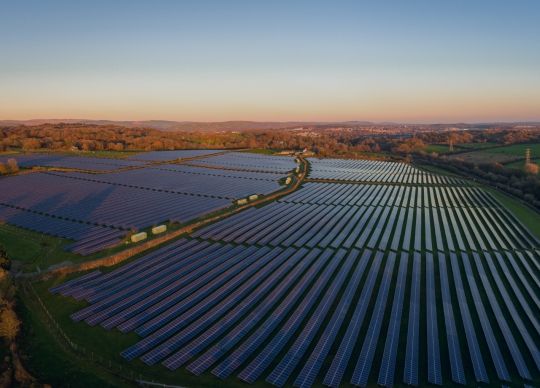
Springwell Solar Farm has received government approval, marking a significant milestone for UK solar generation.
- Capacity: 800 MW
- Status: Approved on 8 April 2026
- Department: Department for Energy Security and Net Zero
- Classification: Nationally significant clean energy project
- Scale: Largest power-producing solar farm in the UK
- Output estimate: Over 180,000 homes powered annually (developer estimate)
This decision represents the 25th nationally significant clean energy project approved since July 2024.
Government approval signals a step change in UK solar
The government has approved the 800 MW Springwell Solar Farm, described as the UK’s largest solar project by power generation. Announced by the Department for Energy Security and Net Zero on 8 April 2026, the decision reinforces the pace at which clean energy infrastructure is now moving from ambition to delivery.
According to the developer, Springwell could generate enough electricity to power more than 180,000 homes each year, equivalent to roughly half the homes in Lincolnshire. For government, however, the project is about more than capacity alone. It is positioned as a response to global instability and the financial risk of relying on fossil fuel markets outside the UK’s control.
Why solar, and why now
Recent geopolitical events have sharpened the focus on energy security. Ministers argue that international conflicts have exposed the cost volatility associated with fossil fuels and highlighted the need for power generation that Britain can control.
Solar is central to that strategy. It is consistently framed as one of the cheapest forms of power available and a technology that can be deployed at scale within the UK. The approval of Springwell builds on a series of measures already announced, including plug-in solar for UK stores, solar as a standard feature on new homes in England, and an accelerated renewables auction timetable.
Taken together, these decisions suggest a clear intent to reduce reliance on imported energy while stabilising long-term costs for households and businesses.
What an 800 MW solar project really involves
At 800 MW, Springwell sits firmly in major infrastructure territory. Projects of this scale bring complexity that extends far beyond panel installation.
Delivery will depend on early alignment between design, civils, electrical balance of plant and grid connection works. Programme certainty becomes critical, particularly where grid availability and commissioning windows can define the overall schedule. Health, safety and environmental management also take on greater importance across large sites with extended construction phases.
In practice, success at this scale is driven by integration. The strongest programmes treat engineering, construction, commissioning and controls as a single system rather than disconnected packages.
Implications for skills and workforce planning
Large-scale solar developments place sustained demand on specialist skills across the full project lifecycle. While solar is sometimes perceived as simple, delivery at this level requires experience more commonly associated with utilities, rail, nuclear and major civils projects.
Key capability areas include electrical engineering at HV and MV level, grid compliance, civil and structural engineering, project controls, commissioning and operational readiness. Leadership roles in health and safety, quality assurance and construction management are equally critical.
For employers, the challenge is less about finding people and more about securing the right mix of skills at the right time. For candidates, solar now offers long-term, technically demanding careers rather than short-term site roles.
Supply chain pressure and execution risk
As project scale increases, risk increasingly sits within the supply chain. Interface management between contractors, consistent QA and documentation standards, and compliance across a mixed workforce all influence delivery outcomes.
High-demand disciplines such as HV engineering, commissioning and project controls are already under pressure across the wider infrastructure market. Without structured resource planning and strong compliance governance, these constraints can quickly translate into programme delay.
Millbank perspective
Springwell’s approval is another clear signal that UK solar has entered a new phase. The conversation is no longer about whether solar can deliver meaningful capacity, but about how reliably it can be delivered at pace.
Projects of this size reward organisations that plan workforce strategy alongside engineering and commercial decisions. Early talent pooling, clear mobilisation planning and robust compliance frameworks are now fundamental to protecting delivery.
Millbank supports energy and infrastructure programmes with compliant, scalable workforce solutions. From contingent staffing and executive search through to managed solutions, resource planning and payroll services, our focus is on reducing delivery risk and enabling critical projects to move forward with confidence.
Frequently asked questions
How big is Springwell Solar Farm?
Springwell Solar Farm has an approved capacity of 800 MW, making it the largest power-producing solar project in the UK.
How many homes could it power?
The developer estimates that Springwell could generate enough electricity to supply more than 180,000 homes each year.
Why is the government prioritising solar?
Solar is viewed as one of the cheapest forms of power available and a key route to reducing exposure to volatile international fossil fuel markets.
What does this mean for jobs and skills?
Large solar projects drive demand for experienced engineers, construction leaders, project controls professionals and commissioning specialists, particularly those with backgrounds in major infrastructure sectors.
When will construction begin?
Construction timelines have not yet been confirmed. Progress will depend on detailed design, grid connection milestones and delivery planning.
Source
Department for Energy Security and Net Zero press release, published 8 April 2026.