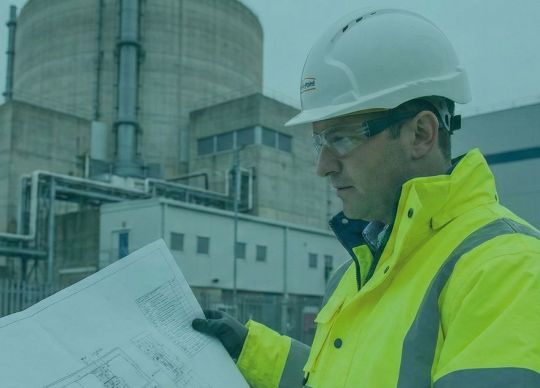
The Office for Nuclear Regulation (ONR) has officially verified Hinkley Point B (HPB) as "Fuel Free."
This verification marks the successful conclusion of a high-intensity engineering programme that has removed over 99% of the site's radiological hazard.
For the UK nuclear sector, this is a critical proof of concept. It confirms that the Advanced Gas-cooled Reactor (AGR) fleet can be defueled on time and on budget.
For the workforce in the South West, it signals a profound shift. The physics of generation has ceased, and the engineering of restoration has begun.
The Milestone by the Numbers
Defueling an AGR is significantly more complex than standard reactors due to the unique fuel design. Since generation ended in August 2022, the team at Hinkley Point B has executed a logistical marathon.
-
4,900+ fuel elements removed from the reactor cores.
-
360 flask movements transported by rail to Sellafield.
-
3.5 Years from shutdown to verification.
This success relied on the "One NDA" supply chain model. It integrated EDF Energy, Nuclear Transport Solutions, and Sellafield into a single delivery schedule.
The Commercial Handover
Currently, we are in the Transition Phase. While the fuel is gone, EDF Energy remains the site licensee.
The official transfer of the Nuclear Site Licence to Nuclear Restoration Services (NRS) is scheduled for 1 October 2026.
Rob Fletcher, CEO of Nuclear Restoration Services, commented on this collaboration:
We have been working alongside the Hinkley Point B team closely for several years as we move towards site transfer... We look forward to continuing our close working relationship as we move towards a seamless transfer and into the site's decommissioning journey.
This handover allows EDF to focus resources on its new build portfolio, including Hinkley Point C and Sizewell C. Meanwhile, NRS will integrate the site into its existing estate for dismantling.
The Skills Pivot: Generation to Restoration
For candidates and clients, this is the most significant takeaway. A station in generation requires operational stability. A station in decommissioning requires project delivery agility.
As highlighted by World Nuclear News, the sector is not facing a shortage of people, but a need for skills translation.
Our analysis identifies three critical pinch points for talent in this new phase:
1. Radiological Protection (RP)
As the primary circuit is opened, areas that were sealed become active work zones. This requires a significant increase in Health Physics Monitors and Accredited Health Physicists to manage contamination control.
2. Project Controls
Decommissioning is a series of complex, high-uncertainty projects. We are seeing high demand for Planners, Cost Engineers, and Risk Managers who can keep these programmes on track.
3. Waste Management
Before a building can be demolished, every component must be characterised. Waste Engineers are now the gatekeepers of value, ensuring clean waste isn't sent to expensive high-level repositories.
Future Context
The success at Hinkley Point B could drive a shift toward Continuous Decommissioning. If sites can be cleared faster, the land becomes available for future energy projects sooner.
As noted in the International Atomic Energy Agency (IAEA) national report, the UK is refining its strategy to accelerate these timelines where possible.
The Fuel Free declaration is a triumph for the UK supply chain. It validates the engineering strategy for the entire AGR fleet.
However, the hard work of environmental restoration is just starting. The challenge now is not technical, but human. We must attract and retrain the specialised workforce needed to take the site from a concrete monolith to a brownfield asset.
Are you ready for the transition?
For Clients: Millbank provides compliant, scalable workforce solutions to manage the shift from OPEX to CAPEX project delivery. Explore our Managed Solutions
For Candidates: If you have experience in Project Controls, Radiological Protection, or Waste Management, your skills are in high demand. View our latest Nuclear Vacancies