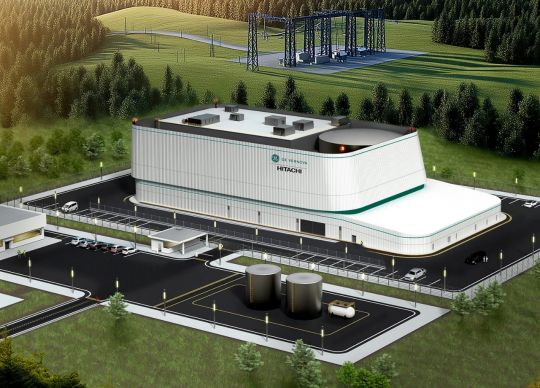
SGE has proposed building 14 GE Vernova Hitachi BWRX-300 small modular reactors across three UK sites.
The privately led programme would provide 4.2GW of generating capacity, with six reactors proposed for the first site and four at each of two later sites. SGE has submitted the project through the UK Advanced Nuclear Framework, but sites, commercial support, licensing and final investment decisions must still be secured before construction can begin.
SGE estimates that the completed fleet could provide the equivalent of around 11% of current UK electricity demand, or enough electricity for almost eight million homes. The company has established SGE SMR UK Limited to develop the proposal in Britain.
Key takeaways
- 14 BWRX-300 reactors are proposed across three UK sites.
- The completed fleet would provide 4.2GW of capacity.
- The first site is planned to host six reactors.
- SGE is targeting first commercial operation in 2034.
- The sites and commercial arrangements are not yet confirmed.
What has SGE proposed?
SGE announced its proposed UK programme on 2 July 2026. The developer describes it as a commercially led, privately financed investment built around repeatable deployment of the same reactor design.
The proposed first site would contain six BWRX-300 reactors, providing 1.8GW of capacity. Two further sites would each contain four reactors and provide 1.2GW.
| Programme detail | Current proposal |
|---|---|
| Developer | SGE |
| UK project vehicle | SGE SMR UK Limited |
| Reactor design | GE Vernova Hitachi BWRX-300 |
| Number of reactors | 14 |
| Number of sites | Three |
| Proposed site configuration | Six reactors, followed by four and four |
| Total capacity | 4.2GW |
| Current status | Application submitted under the Advanced Nuclear Framework |
The announced deployment team includes GE Vernova Hitachi Nuclear Energy, Samsung C&T, Laing O’Rourke, Aecon, Google Cloud, Fermi Development and Etara. SGE has said that an experienced nuclear operator is also involved, although the operator has not yet been named.
SGE plans to pursue a Contract for Difference arrangement with National Wealth Fund engagement. These arrangements have not yet been agreed, and the project has not reached a final investment decision.
We are focused on delivering efficient, safe, affordable, and clean nuclear energy power at fleet scale. We will rely strongly on the UK supply chain; it is a critical element for our project.
Michał Sołowow, Founder, SGE
What is the BWRX-300?
The BWRX-300 is a small modular boiling water reactor developed by GE Vernova Hitachi Nuclear Energy. Each unit is designed to generate approximately 300MW of electricity and operate for at least 60 years.
The design uses natural circulation to move water through the reactor and a direct cycle in which steam produced inside the reactor vessel is sent to the turbine. This removes the need for some of the pumps, pipework and steam-generating equipment found in other reactor designs.
GE Vernova Hitachi has also designed the reactor around passive safety systems. These use natural forces such as gravity and steam condensation to support cooling without relying entirely on powered equipment or immediate operator action.
The first commercial-scale BWRX-300 is under construction at Ontario Power Generation’s Darlington site in Canada. This provides SGE and its delivery partners with a live reference project, although no BWRX-300 is currently operating commercially.
What is the UK regulatory position?
The BWRX-300 completed Step 2 of the UK Generic Design Assessment in December 2025. The assessment was conducted by the Office for Nuclear Regulation, the Environment Agency and Natural Resources Wales.
The regulators found no fundamental safety, security, safeguards or environmental protection shortfalls that would prevent the design from potentially being deployed in England and Wales.
Generic Design Assessment examines the reactor design in principle. It does not give SGE permission to construct a BWRX-300 at a particular site.
Further detailed assessment will be needed, either through a later stage of Generic Design Assessment or as part of site-specific regulatory work. Each project would also require planning approval, environmental permits and a nuclear site licence held by an appropriate operator.
Where could the reactors be built?
SGE has not officially announced the locations of its proposed three sites.
The former nuclear power station site at Oldbury in South Gloucestershire has been linked to the proposed first development. However, Oldbury should not be treated as a confirmed SGE site until an agreement and formal announcement are made.
The Oldbury site is owned by Great British Energy-Nuclear. SGE would therefore need to secure access, a lease or another suitable commercial arrangement before developing the land.
SGE has said that its site partner has assessed more than 100 potential locations and that discussions are taking place around privately and publicly owned land. The complete site list is expected to be released after negotiations have progressed.
| Location | Current status |
|---|---|
| Oldbury, South Gloucestershire | Reported as a potential first site, not officially confirmed by SGE |
| Second UK site | Location not announced |
| Third UK site | Location not announced |
What is the proposed timeline?
SGE is targeting entry into the UK Advanced Nuclear Pipeline in November 2026. It then expects to progress site selection and negotiations around government support during the first half of 2027.
| Date | Proposed milestone |
|---|---|
| July 2026 | UK programme announced and application submitted |
| November 2026 | Target entry into the Advanced Nuclear Pipeline |
| First half of 2027 | Target site selection and support negotiations |
| From 2028 | Target site preparation and licensing activity |
| 2030 | Target final investment decision |
| 2034 | Target first commercial operation |
These dates are developer targets rather than confirmed government or regulatory deadlines. The timescale will depend on site agreements, financing, planning, regulatory assessment and the appointment of a licensed operator.
How does the Advanced Nuclear Framework fit in?
The government published the Advanced Nuclear Framework in February 2026 to support privately led advanced nuclear projects in England and Wales.
The framework introduces the UK Advanced Nuclear Pipeline and a Project Readiness Assessment. This assessment considers areas including the reactor technology, developer capability, financing, site strategy, supply chain and operator arrangements.
Projects accepted onto the pipeline can receive a limited in-principle government endorsement and structured engagement on matters such as future revenue support and investor risk protection.
Pipeline entry is not planning permission, a nuclear site licence, a funding award or a commitment that the project will be built. It gives credible projects a clearer route through the early stages of development.
Why the fleet model matters
SGE’s proposal is based on standardisation, repetition and modular construction across 14 reactors.
Traditional nuclear projects have often been developed as individual programmes with their own designs, supply chains and delivery structures. A fleet approach is intended to reuse the same design, manufacturing methods and construction sequences across multiple units.
The first reactor would still require significant site-specific design and licensing work. Later units could then benefit from established technical documentation, qualified suppliers and teams with direct experience of the same design.
This model could give manufacturers greater visibility of future demand. A supplier may be more willing to invest in nuclear qualifications, equipment and skills if it can see potential work across 14 units rather than one isolated project.
The workforce model could also become more continuous. Specialist teams in areas such as nuclear welding, quality assurance, installation and commissioning could move between units or sites as the programme progresses.
Standardisation, repetition, modularisation, and a fleet deployment strategy are the most effective ways to deliver new nuclear projects successfully, reducing costs, construction risk, and delivery times.
Rafał Kasprów, Chief Executive Officer, SGE
What could the programme mean for the UK supply chain?
SGE has identified UK supply-chain participation as an important part of its proposal. No procurement packages or domestic content targets have been confirmed, but a 14-unit programme could create opportunities across several areas.
- Civil engineering and site enabling works
- Modular construction and advanced fabrication
- Mechanical systems, pipework, pumps and valves
- Electrical, control and instrumentation systems
- Structural steel and nuclear-grade concrete
- Digital engineering and configuration management
- Quality assurance, inspection and testing
- Construction logistics and site mobilisation
- Commissioning, operations and maintenance
Nuclear supply-chain participation requires more than general engineering capability. Businesses need appropriate quality systems, traceability, auditable documentation, qualified personnel and a strong understanding of nuclear safety culture.
A repeated pipeline could give capable UK manufacturers time to build those systems. It could also encourage investment in factory capacity, specialist tooling and workforce development before later units move into production.
Which jobs and skills could be required?
SGE has not published a programme-wide employment forecast, so no total job figure can yet be attached to the proposal.
A fleet of this scale could nevertheless require people throughout development, licensing, manufacturing, construction, commissioning and operation. Relevant disciplines could include:
- Civil, structural, mechanical and electrical engineering
- Control and instrumentation engineering
- Systems engineering and configuration management
- Nuclear safety and safety case
- Project and programme management
- Planning, cost engineering and risk management
- Commercial management and procurement
- Manufacturing and production engineering
- Quality assurance and quality control
- Construction and site management
- Commissioning and operations
- Environmental, regulatory and cyber security disciplines
Some positions would require established nuclear knowledge, qualifications or regulatory experience. Others could draw on technical professionals from defence, conventional power, oil and gas, process manufacturing, utilities and major infrastructure.
Transferable experience would still need to be supported by nuclear-specific training, quality requirements and safety culture. The opportunity is not simply to move people between sectors, but to combine relevant technical capability with the standards required for nuclear delivery.
What needs to happen next?
SGE’s application must first complete the Project Readiness Assessment before the programme can enter the Advanced Nuclear Pipeline.
The developer must then confirm its sites, appoint or name its operator and agree the commercial structure needed to finance the programme. Detailed planning, environmental and licensing work would follow for each location.
Grid connections, cooling arrangements, fuel supply, waste management and decommissioning plans must also form part of the site-specific development process.
A final investment decision is currently targeted for 2030. Until that point, the programme should be described as an active proposal rather than a committed construction project.
Millbank’s perspective
A 14-reactor fleet would create a different workforce requirement from a single standalone project.
Repeated deployment could provide employers, manufacturers and technical professionals with clearer visibility of the skills needed across design, manufacturing, construction, commissioning and operation. It could also increase competition for people already supporting civil nuclear, defence, energy and major infrastructure programmes.
Early resource planning will matter. Businesses considering work in the nuclear supply chain need time to assess their capability, strengthen quality systems and develop the people required to deliver in a regulated environment.
Millbank will continue to follow the proposal as the sites, commercial structure and supply-chain opportunities become clearer.
Considering a move into nuclear?
Experience from defence, power, process, infrastructure and advanced manufacturing may be relevant to future SMR programmes. Explore Millbank’s current opportunities or contact our specialist team to discuss where your experience could fit.
Planning for future nuclear skills demand?
Millbank supports permanent, contract and project-based recruitment across nuclear engineering and delivery. Contact Millbank to discuss talent mapping, resource planning and specialist recruitment support.
Frequently asked questions
Is SGE’s 14-reactor programme confirmed?
No. SGE has submitted the proposal through the Advanced Nuclear Framework, but it still requires site agreements, commercial support, planning permission, regulatory approvals and final investment decisions.
Where would the reactors be built?
SGE plans to use three sites in England and Wales but has not officially announced their locations. Oldbury in South Gloucestershire has been linked to the first six-unit site, although no agreement has been confirmed.
What is the BWRX-300?
The BWRX-300 is a 300MW small modular boiling water reactor designed by GE Vernova Hitachi Nuclear Energy. It uses natural circulation, a direct steam cycle and passive safety systems.
When could the first reactor operate?
SGE is targeting 2034 for the first commercial operation. This is a developer target and will depend on financing, site selection, planning and regulatory progress.
How much electricity could the fleet provide?
The 14 proposed reactors would provide 4.2GW of combined generating capacity. SGE estimates that this could meet around 11% of current UK electricity demand, equivalent to almost eight million homes.
Has the BWRX-300 been approved by UK regulators?
The design completed Step 2 of Generic Design Assessment in December 2025. Regulators identified no fundamental shortfalls that would prevent potential deployment, but this is not permission to build the reactor at a specific site.
How would the programme be financed?
SGE describes the proposal as privately financed and commercially led. It plans to pursue a Contract for Difference arrangement and National Wealth Fund engagement, but these arrangements have not yet been agreed.
How many jobs could the programme create?
SGE has not published a confirmed employment forecast. Potential demand could span engineering, manufacturing, project controls, nuclear safety, quality, construction, commissioning and operations.
What happens next?
The immediate next step is assessment under the Advanced Nuclear Framework. SGE is targeting entry into the Advanced Nuclear Pipeline in November 2026, followed by site and commercial negotiations during 2027.