Key takeaways
- MoD signs nearly £1bn contract for 72 RCH 155 howitzers with ARTEC.
- First deliveries expected 2028; deployable capability before end of decade.
- 500+ British jobs across Telford, Stockport and Sheffield supply chain.
- Reinstates UK large-calibre gun barrel manufacturing after a 20-year gap.
- Demand spans mechanical, software, systems integration and skilled trades.
The Ministry of Defence has confirmed a contract worth nearly £1 billion for 72 next-generation Remote Controlled Howitzers (RCH 155), restoring the British Army's self-propelled artillery capability and creating at least 500 skilled jobs across the UK. The announcement, made on 13 May 2026, is the most significant land programme to follow the Strategic Defence Review 2025 and the first major equipment outcome of the UK-Germany Trinity House Agreement.
What has been announced
The contract has been awarded by the Organisation for Joint Armament Cooperation (OCCAR) on behalf of the British Army to ARTEC GmbH, a joint venture between KNDS and Rheinmetall. The 72 howitzers will be delivered alongside initial training and in-service support, with the first vehicles expected in 2028 and a minimum deployable capability in place before the end of the decade.
The deal builds on two earlier funded steps. In December 2025, the UK and Germany signed a £52 million Early Capability Demonstrator contract. Earlier in 2026, a £53 million Long Lead Items contract included around £30 million to establish a new gun barrel manufacturing facility in Telford. Today's announcement converts that groundwork into the long-term solution for the Army's Mobile Fires Platform requirement.
Defence Secretary John Healey framed the deal in economic as well as military terms, calling it "defence delivering for the battlefield and for Britain's economy." German Federal Minister of Defence Boris Pistorius pointed to NATO interoperability as a practical, not theoretical, output of the joint procurement.
Why the British Army needs this capability now
The RCH 155 will fill a capability gap the Army has lived with since donating its previous self-propelled artillery, the AS90, to Ukraine. An interim solution of 14 Archer wheeled howitzers acquired from Swedish stocks has been bridging the gap, but the Army has been without a long-term self-propelled artillery platform at scale.
Operational lessons from Ukraine have shaped the requirement. Artillery has been responsible for the majority of battlefield casualties on both sides, and the time between target identification and first round on target has shortened sharply. Drone-cued counter-battery fire makes static artillery vulnerable, which is why wheeled "shoot-and-scoot" systems with armoured cabs are now the global trend, from the French Caesar to the Polish Krab, the Swedish Archer and the German-led RCH 155.
The Deputy Chief of the General Staff, Lieutenant General Simon Hamilton CBE, was direct about the implication. The UK knew the risk of supporting Ukraine and accepted the warfighting capability gap that resulted, with the RCH 155 marking the first significant step in replenishing it. The platform fits into the British Army's Future Soldier modernisation programme and the Strategic Defence Review 2025, which set the ambition of tenfold greater lethality within the next decade.
Where in the UK the RCH 155 will be built
Rheinmetall's Telford site, known as Hadley Castle Works, will produce the weapon system components, including the gun barrel. The new "Gun Hall" facility supported by the earlier Long Lead Items contract will reinstate UK large-calibre gun barrel manufacturing for the first time in over two decades, since the closure of Royal Ordnance Factory Nottingham in 2001. The site sits within Telford's wider armoured vehicle cluster, which also produces Challenger 3 and Boxer.
KNDS UK in Stockport will manufacture the Boxer drive module that the RCH 155 sits on. The shared drive module between RCH 155 and the Army's Mechanised Infantry Vehicle programme creates direct industrial commonality and sustains specialist armoured-steel welding skills in the North West.
Sheffield Forgemasters will supply the British steel for the gun barrels, drawing on the £420 million-plus government investment made in the firm over the last year to underpin sovereign steelmaking for defence. The headline figure of 500 British jobs breaks down as 100 at Rheinmetall Telford, 100 at KNDS UK Stockport, and around 300 across the wider supply chain.
What it means for UK engineering skills and the talent market
Programmes like the RCH 155 will tighten rather than relax pressure on the cleared specialist talent pool. The disciplines involved span the full breadth of the defence engineering profession.
The programme draws on forging, large-calibre machining, armoured-steel welding, hydraulic actuation and metallurgy. On the integration side, it pulls in mechanical and systems engineers to combine the drive module, turret, fire-control and communications into one platform. Software, electronics and ballistics specialists support the fire-control, automated loading and remote operation features. Quality, configuration and project management disciplines run across all of it.
The Strategic Defence Review 2025 explicitly referenced a workforce challenge across both military and industrial roles. Engineering UK has estimated the country needs an additional 1.8 million engineers and technicians, with around 48 per cent of engineering employers reporting shortages. Make UK Defence and techUK have both flagged digital skills, cyber and systems integration as areas of particular strain.
The major UK defence employers have been responding at scale, with BAE Systems committing to over 2,400 early-careers hires in 2025 and Babcock planning around 1,500. The government's June 2025 Industrial Strategy included a Defence Skills Package and five new Defence Technical Excellence Colleges. Security clearance timelines remain a real factor in how quickly cleared engineers can mobilise onto programmes, which keeps ex-forces talent and established cleared specialists in high demand.
The RCH 155 work is concentrated in the West Midlands, North West and Yorkshire, three regions that already carry significant engineering recruitment activity for Boxer, Challenger 3 and adjacent armoured vehicle programmes. For engineers in those regions, or those open to relocating, the practical effect is a deeper pool of cleared, programme-anchored opportunities running through the second half of the decade.
How this fits the wider modernisation picture
The RCH 155 contract is one of several major land programmes shaping the UK defence engineering market through to 2030 and beyond. Boxer (623 vehicles), Challenger 3 (148 tanks) and Ajax (589 vehicles) are all running in parallel, with much of the manufacturing concentrated in the same regional clusters.
The Strategic Defence Review 2025 set a "warfighting readiness," "engine for growth" and "NATO first" framework. The Defence Industrial Strategy published in September 2025 followed up by identifying regional clusters as engines of defence-led economic growth, with around 70 per cent of MoD spending with industry already taking place outside London and the South East.
UK defence spending is set to rise to 2.5 per cent of GDP by 2027, with a stated ambition to reach 3 per cent in the next Parliament when conditions allow. For the engineering recruitment market, the practical effect is sustained demand for a small pool of cleared, sector-experienced talent across the West Midlands, the North West, Yorkshire and the West of England.
The Trinity House Agreement adds another dimension. Signed in October 2024, the agreement covers land, sea, air, cyber and space cooperation between the UK and Germany, and the RCH 155 contract is now its flagship industrial output. Bilateral defence work of this kind tends to bring additional UK-based systems integration, test and evaluation, and programme management requirements alongside the core manufacturing footprint.
Millbank's perspective
For engineers working in defence, or weighing a move into the sector from adjacent areas, contracts like the RCH 155 confirm what the wider data has been showing for some time. UK defence manufacturing is one of the most active engineering markets in the country right now, and the demand is regionally concentrated rather than uniformly spread.
For employers, the practical question is less about how big the workforce challenge is and more about how to access cleared specialist talent quickly enough to meet programme milestones. The companies that move early, plan their pipelines deliberately and partner with sector-experienced recruiters tend to be the ones that protect their delivery dates.
For candidates: If you are a defence engineer, or considering a move into the sector from adjacent industries, our specialist team can help you understand where your skills fit across active UK programmes. Speak to our defence team.
For clients: If you are planning workforce demand around active or upcoming land, defence or manufacturing programmes, we can help you map the disciplines and build the pipeline. Speak to our defence team about your hiring plans.
Frequently asked questions
What is the RCH 155 and why is the British Army buying it?
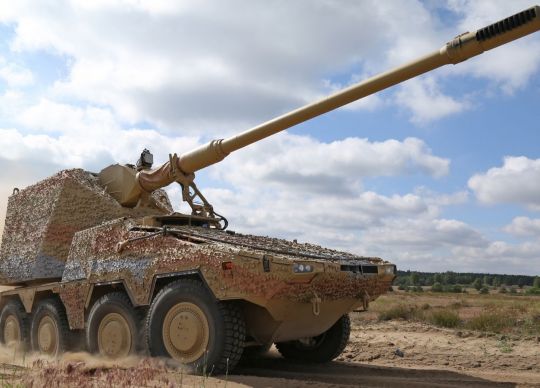
The RCH 155 (Remote Controlled Howitzer 155mm) is a wheeled, self-propelled artillery system mounted on a Boxer chassis. It is replacing the British Army's previous self-propelled artillery, the AS90, which was donated to Ukraine. The Army needs a modern self-propelled platform that can survive on a battlefield where drone-cued counter-battery fire is now standard.
How many British jobs will the contract create?
The Ministry of Defence has confirmed at least 500 British jobs as part of the contract: around 100 at Rheinmetall's Telford site, 100 at KNDS UK in Stockport, and 300 across the wider UK supply chain.
Where in the UK will the RCH 155 be built?
The main UK manufacturing sites are Telford in the West Midlands (Rheinmetall, weapon system and barrel), Stockport in the North West (KNDS UK, drive module) and Sheffield in Yorkshire (Sheffield Forgemasters, steel). The programme will reinstate large-calibre gun barrel production in the UK for the first time in over two decades.
What engineering skills are needed for programmes like the RCH 155?
The work spans mechanical, manufacturing and production engineering, materials and metallurgy, systems integration, electronics, software, ballistics, and quality and configuration disciplines. Skilled trades such as armoured-steel welding, large-calibre machining and forging also sit at the heart of the programme, supported by project management and supply chain expertise.
When will the British Army take delivery?
First deliveries are expected in 2028, with a minimum deployable capability in place before the end of the decade. Earlier funded steps included a £52 million Early Capability Demonstrator contract signed in December 2025 and a £53 million Long Lead Items contract earlier in 2026.
How does this fit into wider UK defence spending plans?
UK defence spending is rising to 2.5 per cent of GDP by 2027, with a stated ambition of 3 per cent in the next Parliament. The RCH 155 contract sits alongside other major land programmes including Boxer, Challenger 3 and Ajax, and reflects the Strategic Defence Review 2025 emphasis on warfighting readiness and the Defence Industrial Strategy framing of defence as an engine for UK economic growth.