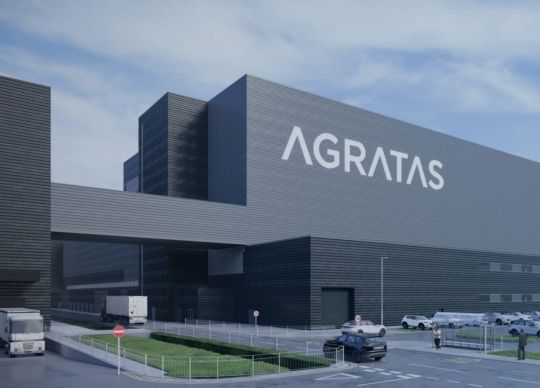
On 9 April 2026, Business Secretary Peter Kyle visited the Gravity Smart Campus in Somerset and confirmed a £380 million government grant to support Agratas in building one of the largest gigafactories in Europe.
This is part of a wider £700m advanced manufacturing investment package. The steel frame is already up. The 16,800 piles are already in the ground. Government funding is now formally confirmed, marking a significant and tangible milestone for the project.
When fully operational, this facility is projected to generate approximately £43 billion in economic growth over 25 years.
Total private investment:
£4 billion
Government grant:
£380 million
Direct jobs:
4,200
Apprenticeships unlocked:
300
On-site workforce within 12 months:
over 2,200
Production target:
Late 2027
Gigafactory capacity:
40GWh (roughly 500,000 EVs annually)
What Has Changed Since December
When we published our first analysis in December 2025, the £380m grant was still in subsidy review with the SAU. That process is now complete. The funding is confirmed.
A few other developments are worth noting. TClarke has withdrawn from the mechanical and electrical delivery team. The battery manufacturing apprenticeship unit we covered previously has now been formally tied to this funding confirmation, giving the talent pipeline genuine institutional backing for the first time.
The broader picture reinforces the momentum. Since the launch of the Modern Industrial Strategy, over £360 billion of private investment has been secured across key sectors, supporting up to 120,000 jobs. The Agratas announcement is the most high-profile expression of that commitment, but it sits within a much larger industrial shift.
The Wider £700m Package
The complete £700m package includes £47m for battery research and development through the Battery Innovation Programme, alongside £190m for the automotive sector through DRIVE35. Of that, £100m specifically targets suppliers in the North East and West Midlands to accelerate the transition to EV manufacturing.
Supply Chain Reality Check
The factory frame has been built using 100% British steel, and the anchor customer relationship with JLR gives the project strong commercial foundations. The grant confirmation adds the final layer of certainty the market has been waiting for.
It is also worth appreciating the dual-phase nature of what comes next. Before a single battery cell is manufactured, the site still requires a substantial construction workforce to complete the build. The transition from heavy construction to advanced manufacturing will run in parallel across multiple disciplines simultaneously, creating broad and sustained demand across the supply chain.
What This Means for the UK Skills Market
With government funding now confirmed, businesses and candidates have a clear signal to act on. The project is moving and the workforce needs to move with it.
The DRIVE35 funding makes this a Midlands story as much as a Somerset one. Suppliers in traditional automotive heartlands are now positioned to compete for specialist talent alongside the gigafactory itself. Understanding that dynamic early is a genuine competitive advantage for hiring managers.
The 2,200 people required on site within 12 months is the number to anchor planning around. The demand is live now. Given the relatively limited pool of specialist battery manufacturing talent in the UK, trans-industry sourcing is not a contingency, it is the primary strategy.
The 300 newly announced apprenticeships are a positive development for the long-term pipeline. They also create an adjacent opportunity: experienced engineers and team leaders capable of mentoring and leading those cohorts will be in strong demand alongside the apprentices themselves.
Three Roles We Are Watching Closely
Process Engineers: Demand for candidates with electrode, slurry, cleanroom, and SPC backgrounds is strong and the available talent pool is tight. We are actively sourcing from pharmaceutical and advanced chemical manufacturing to meet that need.
Quality Engineers: JLR sets a high bar and rightly so. Specialists versed in IATF 16949, APQP, and JLR supply chain requirements are needed at volume. Quality engineering is foundational to scaling a 40GWh operation successfully.
High Voltage and Civil Infrastructure Specialists: Power and water infrastructure must be in place before manufacturing can begin. Grid and utilities specialists are in active demand, and many experienced candidates are currently engaged on national grid upgrade programmes. Early engagement on this profile is advisable given the lead times involved.
The Skills Infrastructure Taking Shape
The Gravity Skills Charter and the Bridgwater & Taunton College partnership remain the backbone of the regional talent strategy. The battery manufacturing apprenticeship unit now has formal funding behind it, a meaningful step forward from the position four months ago.
The green skills deficit remains a wider challenge worth planning around. Around 30% of engineering employers currently report difficulty hiring sustainability specialists. A gigafactory of this scale requires more than production staff. Environmental compliance engineers, sustainable supply chain managers, and waste reduction specialists are all part of the workforce equation.
For Candidates
If you are an engineering professional, the next 12 months represent a genuine window of opportunity. Bridgwater & Taunton College courses in battery manufacturing and high voltage safety are already live and well worth exploring.
If your background is in pharmaceutical, food processing, or aerospace, your skills are highly relevant to this environment. Cleanroom experience, rigorous quality methodologies, and continuous manufacturing knowledge are precisely what this project requires. Updating your profile to reflect those competencies specifically is a practical and worthwhile step to take now.
Millbank: Connecting the Best Talent With the Projects That Matter
For over 40 years, Millbank has supported the UK's most significant engineering and manufacturing projects with specialist recruitment that goes beyond the CV.
The Agratas gigafactory represents a generational shift in UK automotive manufacturing. The teams being built right now will define the success of this project for decades to come.
If you are an employer looking to build those teams, or an engineer ready to be part of something significant, Millbank is your partner for what comes next.