Key takeaways
- Hydrogen delivery is strongest in industrial and port regions.
- HyNet, Teesside and Milford Haven show clear progress.
- HyNet is a major network story to watch.
- Most hydrogen roles use existing engineering skillsets.
- Process, EC&I and project controls skills will be critical.
Why geography matters in hydrogen
Hydrogen infrastructure needs more than a production site. It needs power, water, storage, pipelines, planning consent, safety systems and industrial customers who can use hydrogen at scale.
That is why the UK hydrogen map is being shaped by clusters rather than spreading evenly across the country. Refineries, chemical plants, ports, gas networks, carbon capture routes and power generation assets all influence where projects can move fastest.
The UK Government’s Hydrogen Infrastructure Strategic Planning policy statement points to a coordinated approach to hydrogen networks, with early regional systems expected to play an important role before any wider national hydrogen network develops.
In practical terms, the strongest hydrogen locations tend to have some or all of the following:
- large industrial users
- port or marine infrastructure
- existing gas or utilities networks
- carbon capture or storage potential
- available land for production assets
- engineering supply chains already used to regulated environments
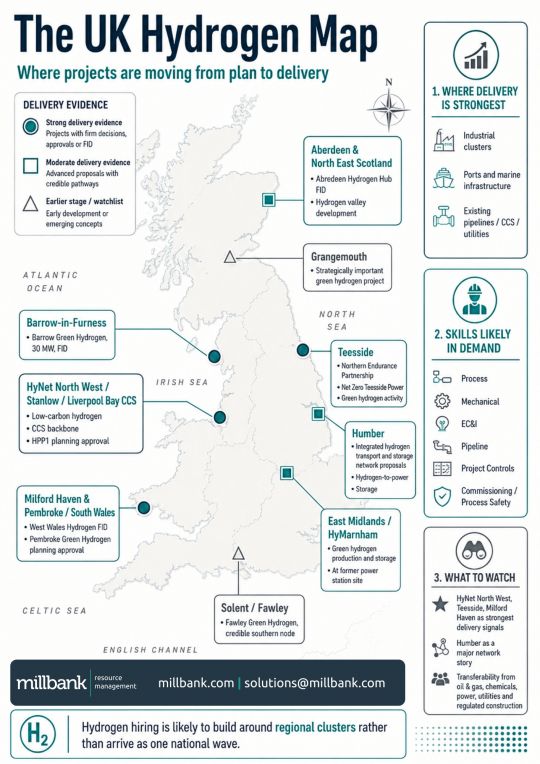
The UK hydrogen map at a glance
| Region | What is progressing | Current evidence | Likely skills demand |
|---|---|---|---|
| HyNet North West | Carbon capture and storage, low-carbon hydrogen production at Stanlow, proposed regional hydrogen pipeline | Liverpool Bay CCS has reached financial close and entered construction. HPP1 has planning approval and government backing. | Process, mechanical, EC&I, civils, pipeline, process safety, commissioning |
| Teesside | Carbon capture infrastructure, low-carbon power, green hydrogen projects | Northern Endurance Partnership reached financial close. Net Zero Teesside Power says construction work is under way. | Compression, controls, EC&I, project controls, process safety, commissioning |
| Humber | Proposed integrated hydrogen transport and storage network, storage, hydrogen-to-power and green hydrogen production | Planning and network development activity is moving, but the integrated network remains a forward-looking opportunity. | Pipeline, storage, civils, EC&I, environmental, project controls |
| Milford Haven and South Wales | Green hydrogen production, direct pipeline links to industry, offshore hydrogen design work | West Wales Hydrogen has reached final investment decision. Pembroke Green Hydrogen has planning approval. | Process, mechanical, EC&I, port infrastructure, permitting, commissioning |
| Aberdeen and North East Scotland | Green hydrogen production, storage, distribution and wider hydrogen valley development | Aberdeen Hydrogen Hub has reached final investment decision. Wider regional scale-up projects are progressing. | Offshore energy, mechanical packages, controls, operations, power systems |
Where the strongest delivery signals are coming from
HyNet North West
HyNet North West is one of the clearest examples of hydrogen being tied to a wider industrial decarbonisation system.
The region combines refinery operations at Stanlow, heavy industrial users, carbon capture and storage infrastructure, and proposed hydrogen pipeline connections across the North West and North Wales. The strongest delivery milestone is the Liverpool Bay carbon capture and storage system, where Eni confirmed financial close with the UK Government in April 2025.
The Liverpool Bay CO2 Transportation and Storage project is intended to provide the carbon dioxide transport and storage backbone for HyNet. That matters because low-carbon hydrogen production at scale depends on having a reliable route for captured carbon.
The hydrogen production side is also moving. EET Hydrogen’s HPP1 project at Stanlow has planning approval, and EET has described it as the first phase of a wider production hub. EET Fuels has also confirmed government backing for HPP1.
The important caveat is the pipeline. The HyNet North West Hydrogen Pipeline update says progression of the Development Consent Order has been paused until there is greater clarity on the hydrogen transport business model. That means the pipeline should not be described as under construction.
Teesside and the East Coast Cluster
Teesside has some of the UK’s strongest delivery evidence, although much of that evidence currently sits around shared carbon capture and power infrastructure rather than hydrogen alone.
The Northern Endurance Partnership announced in December 2024 that it had reached financial close on the UK’s first carbon dioxide transportation and storage infrastructure project. The scheme includes a carbon dioxide gathering network, onshore compression, a 145 km offshore pipeline and storage in the Endurance aquifer.
Net Zero Teesside Power also states that construction work is under way, with the project designed to generate up to 742 MW of low-carbon power.
For hydrogen specifically, the picture is more mixed. The UK Government confirmed contracts for the first wave of hydrogen projects in 2025, including Tees Green Hydrogen, through its hydrogen allocation round announcement.
At the same time, H2Teesside was formally withdrawn from the planning process in December 2025, according to the Planning Inspectorate withdrawal letter. Teesside still matters greatly, but this is a useful reminder that not every announced hydrogen project moves at the same pace.
Milford Haven and South Wales
Milford Haven and South Wales have one of the clearest pure hydrogen delivery stories in the UK.
In March 2026, Trafigura announced that its subsidiary MorGen Energy had reached final investment decision for the 20 MW West Wales Hydrogen project. The project is expected to produce around 2,000 tonnes of green hydrogen per year, with construction due to begin in 2026 and commissioning targeted for early 2028.
Pembroke Green Hydrogen also strengthens the region’s case. RWE confirmed that it had secured planning approval for a green hydrogen plant in Pembroke. The project is planned at around 100 MWe and would use a direct pipeline connection to nearby industry.
The region has a wider offshore and industrial cluster story too. The Milford Haven Hydrogen Kingdom project is exploring offshore hydrogen production linked to the Pembrokeshire Demonstration Zone, while the South Wales Industrial Cluster provides the broader industrial decarbonisation context.
Important regions to watch next
| Location | Why it matters | Status to use carefully |
|---|---|---|
| Humber | SSE, Centrica, Equinor and National Gas have launched Humber Hydrogen, a proposal to support an integrated hydrogen transport and storage network. | Major network opportunity, but not yet the same maturity as Teesside’s core infrastructure. |
| Aberdeen and North East Scotland | Aberdeen Hydrogen Hub has reached final investment decision, while TH2ISTLE Hydrogen Valley and Kintore Hydrogen support the wider scale-up story. | Credible early delivery and strong offshore energy transferability. |
| Barrow-in-Furness | Plug Power announced that the 30 MW Barrow Green Hydrogen project had reached final investment decision. | Strong targeted project, useful proof that hydrogen is not only a mega-cluster story. |
| East Midlands | Hydrogen UK has covered the HyMarnham project, a green hydrogen production and storage project based on a former power station site. | Targeted regional project, not a full industrial cluster. |
| Grangemouth | RWE’s Grangemouth Green Hydrogen project is active and strategically important. | Important to monitor, but still earlier stage than the clearest delivery regions. |
| Solent and Fawley | Hynamics has set out plans for Fawley Green Hydrogen, linked to the industrial base around Fawley. | Credible southern node, but still more planning-led than construction-led. |
Which projects are closest to delivery?
| Evidence level | Examples | How to describe them |
|---|---|---|
| Strong delivery evidence | West Wales Hydrogen, Liverpool Bay CCS, Northern Endurance Partnership, Barrow Green Hydrogen | These have final investment decision, financial close, construction evidence or execution-stage evidence. |
| Moderate delivery evidence | HPP1 at Stanlow, Humber hydrogen network proposals, Aberdeen Hydrogen Hub, HyMarnham | These are credible and active, but individual project status should be described precisely. |
| Earlier stage or watchlist | Grangemouth, Solent and Fawley, some wider regional hydrogen networks | These should be positioned as important projects to monitor, not as fully committed build-out. |
What this means for engineering skills
Hydrogen is not creating an entirely new labour market from scratch. Much of the work will be delivered by existing engineering disciplines being applied to new plant, new networks and new industrial systems.
The Engineering Construction Industry Training Board has highlighted that many of the roles needed for hydrogen are already familiar across engineering construction, including process engineers, technicians, welders and pipefitters.
| Project stage | Likely roles | Why it matters |
|---|---|---|
| Development and planning | Environmental specialists, consenting professionals, project controls, safety advisers | Needed before major site activity begins. |
| Design | Process engineers, mechanical engineers, EC&I engineers, pipeline and utilities designers | Turns concept, funding and planning into deliverable plant and infrastructure. |
| Construction and installation | Civils, pipefitters, coded welders, electrical installation, site managers, QA/QC | Supports site mobilisation, plant installation and industrial tie-ins. |
| Commissioning | Commissioning engineers, controls specialists, systems completion teams, process safety professionals | Brings new plant and systems online safely. |
| Operations and maintenance | Maintenance technicians, reliability engineers, inspection teams, controls technicians, plant operators | Supports long-term performance after handover. |
For Millbank’s markets, the strongest crossover is likely to come from oil and gas, refining, petrochemicals, chemicals, power generation, utilities, water, nuclear, process manufacturing and regulated industrial construction.
What candidates should take from this
Candidates do not need to wait until they have direct hydrogen experience to be relevant.
Experience with hazardous environments, gas handling, high-pressure systems, industrial utilities, control systems, commissioning, shutdowns, maintenance, quality and process safety can all transfer into hydrogen projects.
Make these skills visible on your CV:
- gas compression or high-pressure pipework
- EC&I systems, controls, DCS or PLC experience
- COMAH, DSEAR or hazardous area exposure
- commissioning, start-up or systems completion
- regulated site experience
- utilities, water treatment or high-voltage interfaces
- project controls, planning or cost management on complex industrial work
A CV that only says “oil and gas engineer” or “process engineer” may undersell your fit. A CV that shows the plant, systems, project stage and safety environment you have worked in is much easier to map against hydrogen requirements.
What employers should take from this
Hydrogen projects need technical input long before construction starts. Consenting, environmental planning, process safety, utility connections, design, project controls and interface management all require experienced people early.
Three workforce planning points stand out:
- Start before final investment decision. Waiting until site mobilisation can leave employers competing for the same limited pool of senior technical specialists.
- Plan by region, not just job title. The North West, Teesside, Humber, South Wales and North East Scotland will each have different competition from nearby energy, utilities, process and infrastructure work.
- Recruit for adjacent competence. The hydrogen-specific talent pool is still developing, so employers will need to assess transferable experience from regulated industrial sectors.
The hardest roles to fill are likely to sit where novelty, regulation and delivery pressure overlap. Senior process engineering, EC&I, controls and automation, process safety, project controls, pipeline engineering, environmental consenting and commissioning leadership should all be planned early.
Millbank’s perspective
Hydrogen will be delivered by known engineering skillsets in new combinations.
The projects now moving forward need people who understand complex plant, regulated environments, technical documentation, safety, commissioning and long-term operations. That creates opportunity for candidates with the right transferable experience, and a planning challenge for employers competing for the same specialist skills.
For candidates, hydrogen offers a route into one of the UK’s most important emerging energy markets. For employers, early workforce planning will be essential as regional competition increases.
If you are an engineering professional looking at where your skills could fit into the hydrogen sector, speak to our team about current and upcoming opportunities.
If you are planning future hiring around hydrogen, energy transition or industrial decarbonisation projects, Millbank can support workforce planning, talent mapping and specialist technical recruitment.
FAQs
Where are the biggest hydrogen projects in the UK?
The most important hydrogen regions include HyNet North West, Teesside, the Humber, Milford Haven and South Wales, Aberdeen and North East Scotland, with further activity in Barrow, Grangemouth, the East Midlands and the Solent.
Which UK regions are leading on hydrogen infrastructure?
The strongest delivery evidence is currently concentrated in industrial and port regions. HyNet North West, Teesside and Milford Haven show particularly clear progress, while the Humber is an important network story to watch.
Is hydrogen actually being built in the UK?
Yes, but project maturity varies. Some projects have reached final investment decision, construction or commissioning stages. Others are still in planning, front-end engineering design, consultation or funding allocation processes.
What engineering jobs are needed for hydrogen projects?
Likely roles include process engineers, mechanical engineers, EC&I engineers, pipeline engineers, project controls specialists, commissioning engineers, process safety professionals, environmental specialists and operations and maintenance technicians.
Can oil and gas engineers move into hydrogen?
Yes. Oil and gas experience can be highly relevant, especially where it involves gas handling, high-pressure systems, hazardous areas, major projects, commissioning, maintenance, inspection, process safety or offshore infrastructure.
What skills transfer into hydrogen engineering?
Transferable skills include process plant design, mechanical packages, control systems, hazardous area work, COMAH, DSEAR, pipeline engineering, utilities, high-voltage systems, commissioning and regulated project delivery.
What is the difference between green and blue hydrogen infrastructure?
Green hydrogen is produced using electricity, typically from low-carbon or renewable sources, through electrolysis. Blue hydrogen is produced from natural gas with carbon dioxide captured and stored. The infrastructure needs can differ, but both require strong engineering, safety and project delivery capability.
How early should employers start hiring for hydrogen projects?
Employers should begin workforce planning before construction begins. Development, consenting, safety, design, project controls and commissioning planning all require specialist people well before a project reaches full site mobilisation.